


This page brings together some of the impacts and outcomes we saw during Catalyst CIC’s lifetime. You can read our final report below and view older reports via the footer.
Legacy note
Catalyst CIC closed in March 2026. This page is now part of a static archive of our work between 2024–2026.
Annual Impact & Learning Summary 2025–26
Ending well, and seeding what comes next
2025–26 has been a year of endings and beginnings for Catalyst.
Last year, the Tech Justice Roadtrip demonstrated that a model of sociocratic, Global Majority-led design, decision making and learning can unlock huge creativity and value for people united by shared vision and values. As it came to an end, we paused to reflect on the role Catalyst might best play next in the emerging tech justice field.
This led to the strategic decision to close Catalyst CIC. We used our final phase to support what could continue beyond us:
- funding emerging tech justice work
- strengthening relationships across the field
- sharing learning openly
- stewarding our assets and infrastructure into new homes.
This period of degrowth has been one of our most intentional phases – focused on moving resources, relationships and attention into the wider ecosystem in ways that can outlast the organisation.
Key activities 2025-26
1. Choosing to close – and creating the conditions to do so well
The decision to close the CIC was informed by a number of things:
- a constrained and shifting funding landscape – while we had enough funding to continue for a while, we were struggling to raise new funds within an increasingly small window of for the kind of work we wanted to do
- a recognition that tech justice work is most powerfully led by those closest to its impacts
- an internal sense that Catalyst CIC was not always the right long-term vehicle for this work, coupled with the directors’ personal desires to step away from the CIC.
As we made the decision we asked what responsibility looks like at the end of a cycle. We held 1:1 conversations with partners, collaborators and peers, and integrated their thinking, perspectives and insights. These helped shape a proposal to close that we then agreed through a sociocratic team decision in 2026.
The closure process was stewarded by a ‘closure working group’ consisting of two directors and two freelancers who had had close ongoing relationships with Catalyst. Together we visited The Deceleration Assembly event in Birmingham to learn from peers navigating similar efforts. As a quartet we have held the patient and detailed work of closing Catalyst well. We’ve shared our learning through regular updates and reflections in our newsletter and on LinkedIn.
Our final six months involved two key funding rounds – one to kindle new work in the tech justice movement, and one to compost our previous work and learning. In retrospect, we were modelling the Berkana Two Loops model of systemic change: hospicing the old while simultaneously feeding and enlivening the new.
2. Kindling: funding, connection and collective momentum
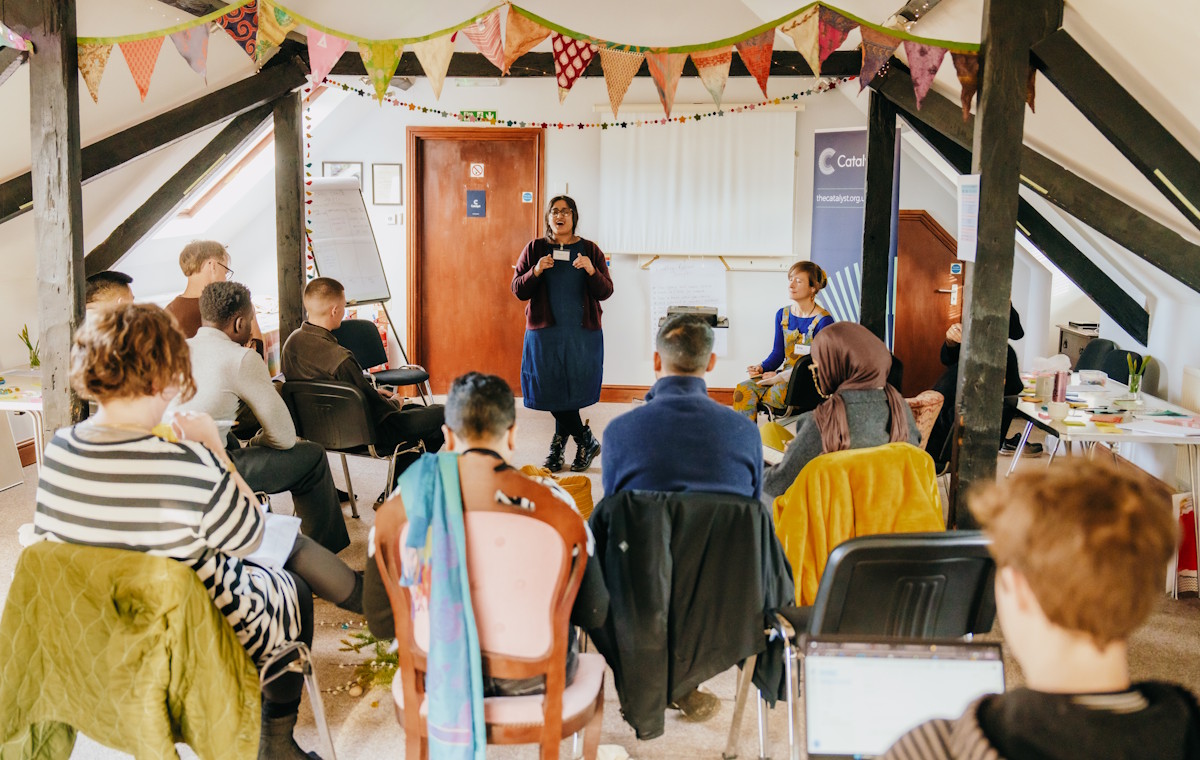
Kindling was Catalyst’s final microgrants programme. We wanted to leave the community with kindling – to nourish what has been, what is, and what might be ready to start. We designed the Kindling programme both as a funding opportunity and an in-person connection space.
Kindling in numbers:
- 92 applications received, showing the breadth and depth of tech justice work in the UK.
- 10 projects funded – you can read about them.
- 2-day residential retreat (February 2026, Oxfordshire), which you can read about here.
- Grants increased from £3,000 to £4,000 to recognise grantee commitment and support participation in the retreat
We used Catalyst’s four values of love, interdependence, equity and curiosity to guide our grantee selection, shortlisting 27 applicants before selecting 10.
We gave detailed and considered feedback to unsuccessful shortlisted applicants, and to others who requested it. Then we published our reflections on the process.
Our feedback included suggestions of connections and next steps to support peoples’ work even when we couldn’t fund it. It received very positive reactions.
“I really appreciate the thoughtful and candid feedback… I will take this away and reflect on how we frame the work, including being more explicit about whose needs we are currently meeting, where bias might be shaping reach, and what we would need to do differently to engage communities.” – Unsuccessful applicant
We also commissioned a couple of unsuccessful applicants to write articles for the Catalyst Medium, giving them an alternative platform to promote their work.
We partnered with Weaving Liberation on the final decision-making. Their Europe-wide digital rights and justice convening experience is complementary to Catalyst’s. They also joined the retreat and participated in follow-on convenings with legacy stewards. This collaboration became a passing of the baton – not just of funding, but of relationships, trust and convening energy within the tech justice ecosystem.
The retreat centred care, connection and shared learning. Through thoughtful design and preparation, including a comprehensive event guide, participatory open space format and decorating the venue with cosy elements we created the conditions for relaxation and real, honest conversations.
Participants:
- formed peer accountability groups
- initiated independent collaborations
- continued conversations via a post-retreat Signal group.
“The space was designed with such care and love… The retreat reminded me of my own biases and how connection often challenges them. It’s important to prioritise relational work with others.” – Retreat participant
Afterwards we wrote about care as infrastructure and creating liberatory spaces.
3. Legacy stewardship: passing work back into the tech justice movement

In parallel with Kindling we considered how to create a strong legacy from Catalyst’s work.
We invited expressions of interest from people interested in stewarding Catalyst’s legacy into the future. From 13 submissions, we held a series of 1:1 calls to codesign and develop a set of stewardship relationships across the ecosystem.
We also funded a Tech Justice Legacy Coalition, convened by Multitudes, to support connection and learning amongst the legacy stewards. We also connected Kindling grantees into the coalition and supported early collaborations.
4. Publications 2025-26
Alongside this, we published three pieces of deep and thoughtful work as a follow-up from last year’s activity:
Tech Justice Road Trip Project Report (2025)
We worked with network partners inFocus and Nikita Shah to co-develop a decolonial evaluation framework for the Roadtrip, which ran from autumn 2024 to spring 2025. This approach centres equity, lived experience and relationships, and actively challenges extractive or top‑down ways of defining success.
The report captures the conditions that helped justice-led partners experiment, organise and imagine more liberatory relationships with technology. It explores how the project distributed around £90,000 across ten activities, including trauma‑informed feminist AI work, participatory grantmaking, community research, reflective spaces and storytelling – of what became possible through this model, and what remained hard.
It offers five key recommendations, which we built into our Kindling programme:
- Begin with relationships and human connection
- Build in longer and more flexible timelines
- Develop and share transparent payment frameworks
- Make reflection a rhythm from the outset
- Design with care, access and wellbeing at the centre.
Decolonising Evaluation Workbook (2025)
Collated by inFocus, the workbook is a practical, reflective tool for rethinking how to evaluate services and projects with communities. It built on earlier iterations of decolonial evaluation work we funded in previous years.
It was co-created with workshop participants in April–May 2025 and is grounded in their lived experience and their prompts towards our evaluators. It shows how to move teams away from extractive approaches and towards methods that are participatory, relational, and culturally relevant.
Sector analysis on digital inequity and power (2025)
We surfaced data from the 2025 Charity Digital Skills Report that told a consistent, but under-reported, story: charities led by minoritised groups are doing some of the most inclusive, values-aligned and ethically cautious digital work, while facing the biggest structural barriers to funding and power.
Five tech justice issues that stood out were:
- Co-design is shallow and minoritised people are structurally excluded from decision-making
- Equity work is led by minoritised charities but starved of funding
- Those closest to harm are doing the most to avoid harmful AI and tech risks.
- Digital capacity is weakest in the regions that need it most
- AI enthusiasm is outpacing strategy and inclusion
We offered practical steps to shift these trends and foster more liberatory digital practice, and followed our own advice in the way we implemented our Kindling and legacy programmes.
5. Resourcing care: Wellbeing Support Bursary Fund

One of the most direct ways we responded to our learning was through the continuation of the Wellbeing Support Bursary Fund.
This provided small, flexible grants to support rest, care and personal wellbeing for people working in tech justice – recognising the emotional and relational cost of this work.
We distributed over £8,000 (more than 10% of our Activities budget) through 36 payments across the year.
The positive feedback we received validated our earlier conclusion that supporting (and resourcing) personal wellbeing cannot be a ‘nice to have’ if we want tech justice work to be sustainable.
“It was such a boost to hear that it was going to be possible and I’m feeling the positive impact already.” – Bursary recipient
“It’s rare to see care resourced so directly. It made me feel like my wellbeing wasn’t separate from the work, but part of it. This really will make such a difference for me.” – Bursary recipient
This reflects a shift in approach from:
- funding outputs towards funding people
- sustainability as an unresourced expectation towards sustainability as something resourced.
We hope this becomes a standard element in funder practice.
Key learnings
Strategic, systemic and personal lessons from this year.
1. Ending well is a social justice imperative
Intentional, careful closure can redistribute value – rather than letting knowledge, relationships and resources dissipate. Organisations and the people in them can utilise their power and affect real change through ending well.
We were inspired by Katya Smith, of former US movement-builders, Full Frame Initiative, who shared lessons from her own organisational closure via a webinar we heard about through The Decelerator network:
“Ending well is a social justice imperative… Closure in a justice organisation is an opportunity for shape-shifting and power transition. How we end an organisation, a programme or anything else is an expression of values.” – Katya Smith
2. Minoritised communities are the canaries – and the architects
Tech justice is work that many people – particularly people of colour, disabled people, migrants and others at the sharp end of tech harms – have been doing for a very long time, often without calling it that, and often without institutional backing.
One of the clearest and most memorable moments at our Kindling retreat was when one of our Kindling grantees described Black and global majority people as “the canary in the coal mine” – those who are most alert to the harms of tech that eventually will harm more of us.
This echoed our Charity Digital Skills Report data analysis, showing that charities led by minoritised groups are doing the most to address the tech harms they experience, despite being structurally under-funded.
3. Understand the most helpful role you can play in a system
Catalyst did not hail from grassroots, where tech harms land first, and where people are already doing the work of reimagining and rebuilding. We came with a different history: as a network, with funder relationships, and a degree of institutional privilege. Catalyst held money, convening power, and a kind of sector legitimacy that many groups doing tech justice work don’t automatically have.
We always recognised the great responsibility inherent in that. And tried to name tensions, such as having a majority white team in spaces that should be by, for and with people of Global Majority descent. We discussed and reflected on questions of power in justice work, such as what is required of white privilege in these spaces? What’s a good way to use it without reinforcing dominance patterns? How do you show up as an intermediary – between big funders and smaller, more precarious groups – without simply passing on the pressure you receive?
We explored this in greater depth, enabling us to practice advocacy through closure in What our ending reveals.
4. Justice-led work requires different funding conditions
Our project experience has repeatedly highlighted that short-term, project-based funding continues to limit what is possible. Especially in work that seeks to redress historical imbalances and support participants fairly and reciprocally. More flexible, long-term approaches are needed.
Connection, rest and emotional safety are not optional extras in justice organising – they are conditions for meaningful and sustainable work. Care and relational work shape outcomes and need resourcing.
5. Personal lessons
Some additional personal lessons we gained along the way.
Even sound decisions can’t bypass grief
The decision to close brought a mix of emotions and reflections, and each team member has undergone their own unique grief process around it.
In communicating the closure to our partners, we heard experiences of Catalyst reflected back to us that were beautiful and touching, as well as reflections that prompted discomfort and sadness.
Having some distance and seeing the organisation as something that could end, rather than continue by default, brought new perspectives on the value and meaning of our work.
We created time and space to connect around the different feelings and reactions coming up through dedicated fortnightly culture meetings. These were invaluable for helping us metabolise the learnings of the process, individually and collectively.
Endings bring things into sharper focus
As we progressed into delivering Kindling and the legacy partnerships, we frequently reflected in Closure Working Group meetings how enjoyable it was to be working towards a clear, fixed timeline and set of goals – perhaps for the first time in Catalyst’s history!
We found freedom in the creative constraints that come with having a designated end-point. Where we could focus on the present without simultaneously trying to secure a future. It allowed us to create manageable, yet still ambitious, plans of work, and to dedicate the time and care to doing it well – all of which fostered high work fulfilment and motivation.
The feelings scale we used in our culture meetings was a helpful barometer of this over time, and a great jumping-off point for more vulnerable and honest conversations.

It also made us reflect, what if more organisations planned for, and were structured around, regenerative cycles of birth, maturity and composting – rather than continuous existence and growth? And what if this was the intention from the outset? It’s a regenerative pattern that mirrors the Kongo Cosmogram, which we used in our early planning for the CIC’s end phase.
What continues beyond Catalyst
Catalyst’s closure is the end for the CIC, but not for tech justice work across the UK.
Across the ecosystem, we are already seeing:
- ongoing collaboration between Kindling projects
- new infrastructure for storytelling, funding and evidence
- continued convening through legacy stewards
- informal networks sustaining connection
The Catalyst website will remain as a maintained archive, and key tools and resources will continue to evolve in new homes.
What remains is not a single organisation, but a living network of relationships, practices and resources.
A closing reflection
Catalyst’s final year has been shaped by a simple question: what does it mean to act with integrity at the end of a cycle?
Our answer has been to:
- slow down
- pay attention
- prioritise the health of the wider ecosystem.
This has meant making space – for others to lead, for relationships to deepen, and for the work to take new forms.
We hope this contributes to a wider shift: where endings are not seen as failures, but as part of how movements adapt, regenerate, and continue.
Postscript: here’s what some network members had to say about Catalyst’s work.
“Catalyst is really, really thinking about power and notions of liberation and collective responsibility around technology. That’s exactly the kind of maturity we need in our sector.”

Hera Hussain, Chayn, Community Member
“Catalyst has a great way of exploring, taking the next step while reaching into communities. Also working at the other end of the scale with funders, and bringing everyone together. There’s such a possibility of magic happening.”

Linda Humphries, former Steering Group Member
“Catalyst stands out by putting social justice front and centre – there’s a real sense of principle and integrity.”

Andy Curtis, Paul Hamlyn Foundation - network member
Check out our earlier annual impact reports below.

The Catalyst network’s 2024/25 highlights
2024/25 was a turning point for Catalyst. Becoming an independent Community Interest Company let us put justice at the heart of our work. Our achievements...

2025 Annual Impact Report
Catalyst’s 2025 impact report highlights our transition to an independent CIC, deepening tech justice work through collective power, participatory governance, and liberatory digital infrastructure.

2024 Annual Impact Report
This story-led report highlights the network's transition to an independent Community Interest Company (CIC) and its impact on nonprofit organisations and their communities.

2023 Annual Impact Report
In this story-led report you will learn about the real impact of Catalyst on the ground, and particular insights and learnings about what collectively shaping...