


What our ending reveals
19th March 2026
Share this article


Ellie Hale

Joe Roberson

Kate Swade

Quick links
Systemic lessons and calls to action from Catalyst CIC’s closure.
We chose to close Catalyst CIC knowing it might land as a shock. Endings are still treated as failures in our sector, not as part of how work changes shape. Our decision to de‑grow and then close is one way we’re acting from our values of care, reciprocity and interdependence.
Since October 2025 we’ve talked openly about why we’re closing, what will end, and what we hope will continue. We’ve described it as composting, not collapse – returning assets, resources and learning to the field, not holding on until we burn out or quietly disappear. We feel grief, relief and pride in different measures, and heard the same mix in consultation calls and at our Kindling retreat.
Catalyst also has a long history of transitions. We’ve shifted from a field‑mapping collaborative, to a crisis response network, to a delegated grant‑maker, to a nonprofit services and infrastructure network, to a sector research and analysis hub – and most recently to a small organisation helping convene and amplify the UK tech justice movement. Reinventing ourselves in response to what we were seeing and hearing has been one of our core practices.
“Transitioning an organisation is different to starting something new – you’re not starting with a blank canvas. You have a reputation, expectations and relationships that already exist, and that take energy to compost even while you’re imagining and seeding the new.” — Kate
We’re writing mainly to people organising for tech justice – activists, community groups, intermediaries and the funders who back them. This article sits inside our final transition.
What our ending reveals about the system
When we paused in 2023 to ask “what most needs catalysing now?”, our review pointed clearly towards the intersection of tech and power. We were attracted to some hard questions (around governance, ownership, equity and ethics) that get at the core of some of the deepest divisions in our society. This developed into an exploration of tech justice and liberatory approaches to technology.
Our role has been to connect, translate, support and help define a new field – intermediary forms of work that are harder to see and to value.
Catalyst grew out of earlier tech-for-good efforts and shifted focus over time to convene emerging tech justice activity in the UK under a shared banner. Our review process helped us notice those needs and gaps, and move towards where we felt we could be most useful.
But once we were there, we had to acknowledge an important truth: the tech justice field needs more genuinely grassroots-initiated, by‑and‑for organisations and funds than Catalyst CIC was ever going to be.
“What’s needed now is a genuinely bottom‑up approach to this work… our role has been primarily to use our networks and influence to signal that tech justice is important to pay attention to… but to actually do the work and continue growing and developing it should be led by those most affected – the ‘canaries in the coalmine’ as one of our Kindling grantees put it.” — Ellie
Closing the CIC is one way of honouring that realisation, and a response to overstretch. Even with committed funders, we were running on thin reserves of money, time and personal capacity. Continuing as we were would have meant ignoring that the best energy and opportunity for this work sits elsewhere now.
Justice, tech and who is asked to carry the cost
Tech justice work starts from a simple observation: technology is not neutral. It can deepen existing inequalities and create new forms of harm, especially for communities already targeted by racism, ableism, misogyny, classism and other intersecting oppressions.
In our network we’ve seen this in digital policing, data‑driven welfare systems, biased AI, and in unequal access to devices, connectivity and skills.
Despite this, digital and data work that tackles this head-on and centres justice is still mostly treated as ‘nice to have’. It is funded as a niche project or short‑term experiment. There’s a widening digital equity gap in the social sector, which typically isn’t addressed by funder or leadership priorities. Many proposals we’ve seen over the years assume technology will increase equity and justice, but too often they replicate the status quo – and sometimes the same inequalities – they say they want to address.
People and communities most harmed by tech injustice are frequently asked to lead the work of naming harms and designing alternatives. They are invited into consultations, advisory boards, co‑design processes and panels, without always being given the time, safety or resources that would make that work sustainable.
“A lot of the language and conversations around tech are made very inaccessible, and that’s a strategy to prevent people from getting involved… digital tech is something people imagined, so we can also imagine it and make it ours.” — Laurence Meyer, Weaving Liberation
We have not always got this right. We’ve tried to centre lived experience, pay people for their time and wisdom, and build relationships slowly. We have also made decisions that created pressure for partners, compressed timelines, or brought people into foggier processes than we’d have liked.
We’ve learned that when you hold funding and convening power, even in a small way, it changes how your invitations land. When we don’t acknowledge that institutional power honestly, we risk contributing to the same patterns we want to dismantle.
“I used to be confused and frustrated when partners saw Catalyst purely as a funder, and I kept trying to encourage people to see themselves as part of Catalyst, the network. But when in reality the money sits in one bank account and strategic decision-making isn’t fully shared, that naivety can become irresponsible.” — Ellie
At the same time, we’ve glimpsed what it feels like to do this differently.
Our Wellbeing Fund offered small, no‑strings grants directly to individuals to support their rest, resilience and healing. Feedback was so affirming that we ran it two years running.
Our reciprocity practices – paying people for attending events, recognising emotional labour, offering support where we could – were attempts to meaningfully recognise peoples’ time, experience and care.
“Tech justice is really about building relationships that are beautiful and meaningful and built for us, not to extract from us.” — Project participant
These were modest interventions, but they felt like steps towards a different way of resourcing tech justice work.
Recurring barriers (and what they tell us)
We kept meeting the same systemic barriers, some of which we also contributed to.
1. Scarcity‑driven, short‑term cycles
Our grants came with fixed timeframes, often tied to our own financial and impact reporting deadlines with our core funders. Programmes like the Tech Justice Roadtrip sometimes had to start late and end early to fit funding windows.
Partners adapted because they’re used to this, but it created crunches and trade‑offs: less time for relationship‑building and meaningful inclusion, more pressure to hit milestones, more stress for the people coordinating the work. We learned to push back on timelines where we could, but we didn’t always succeed, and partners sometimes carried the strain.
2. Innovation logics over justice logics
Across the wider ecosystem, many funders and leaders still prioritise ‘innovation’ over justice. Some of this seems to be a crisis of storytelling. It’s all too easy to buy into the narrative that ‘bigger and shinier’ is also ‘better and more exciting’ – rather than optimising for nuance, inclusion or ethical caution. Or the unsexy behind-the-scenes infrastructure that knits everything together and makes it work.
When innovation is defined as new tools and products, and not as deepening community‑led solutions and reciprocity, justice work gets sidelined and under‑resourced.
At Catalyst we moved away from digital transformation and capacity‑building as end goals, and towards tech justice and organising. That came with costs and tensions of its own, like becoming less attractive to many funders, as we pushed against innovation logics.
3. Undervalued relational and shared infrastructure
Much of Catalyst’s work has been relational: convening networks, hosting conversations, stewarding shared resources like the tech injustice evidence repository, co‑creating guidance with partners. This is infrastructure, even if it doesn’t look like a physical resource or software. It is expensive in time and energy and essential for long-term systemic change.
Relational infrastructure is the real infrastructure needed for justice work, not just technical capacity. It’s the work of building human connections, shared understanding and practiced solidarity – all of which take time to grow and don’t follow a linear path when they do. Yet we and others have repeatedly had to justify why bringing people together, building shared analysis, or holding space is worth funding at all.
“Meeting other people who are values aligned has been both affirming but also inspirational.” — Kindling participant
This nudged us to treat convening and relationships as core work to fund and protect, not as a “nice to have” overhead.
4. Power and representation gaps
As an intermediary funder, we had the chance to experiment with how funding decisions are made. We did some of that through participatory processes, co‑designed programmes and shared decision‑making structures. We also fell back on more traditional approaches at times, especially when we were stretched.
We’ve learned from and alongside other funds that are going further: participatory grant‑makers like Edge Fund and Baobab, and initiatives like Weaving Liberation’s upcoming participatory digital justice fund, where people most affected by injustice hold real decision power.
“You can’t be attempting to distribute power on the one hand while privileging a small group of people on the other.” — Kate
Taken together, these barriers tell us that Catalyst’s ending is not just about one organisation’s choices. It is part of a wider pattern in which justice‑centred digital work, shared infrastructure and small or experimental organisations live in a constant state of precarity, even as demand for their work grows.
What we learned about doing this differently (and where we hit our limits)
Alongside these barriers, there were practices that felt like glimmers of a more liberatory way of working. We hope they can be strengthened and carried forward by others.
Practising degrowth and conscious endings
In 2024 we made a deliberate choice to slow down – to ‘do less, but better’ – so we could relearn, reconnect and pay attention to the tech justice field we were moving into. That deceleration created the conditions for our decision to close. It gave us the space to notice misfits, consult partners, and design a transition that felt more like composting than collapse.
Funding people and relationships, not just projects
The Wellbeing Fund and our reciprocity practices were experiments in taking seriously the emotional and relational labour at the heart of tech justice work. Instead of only funding outputs, we funded rest, care and connection: small grants for therapy, nature time and creative practice; payments for participation; flexible support for community‑led work through programmes like Kindling. These experiments were small, but they felt like some of the most aligned things we did.
Moving towards participatory, bottom‑up approaches
We’ve learned a lot from trying to design programmes and decisions that share power – and from seeing where we fell short. Structures like the tech justice circle showed us how much richer and more creative work becomes when decision‑making is shared.
At the same time, we hit the limits of how far we could go as an organisation that wasn’t originally born from the communities most affected by tech injustice. That’s part of why we’re closing: we’d rather see resources move more directly to by-and-for funds and groups, including those we’ve collaborated with, than keep holding a central role by default.
We are proud of these experiments, and honest that we didn’t always live up to our principles. We hope our attempts, successes and failures can still be useful.
Calls to action for funders, infrastructure bodies and the sector
Our closure offers some evidence about how current funding and governance patterns help and hinder justice‑centred digital work. An open space session on ‘what do we need from funders?’ at our Kindling retreat gathered additional views and experiences from other organisations, and pointed to many of the same or similar issues.
The question is, what we do with that evidence?
For funders
- Fund infrastructure and relationships, not just projects
Treat organisations and collectives that hold shared, relational or digital infrastructure as essential, not peripheral. Offer longer‑term, core‑plus‑programme funding that recognises the time and care needed to convene, translate and steward.
- Back intermediaries and field‑builders who hold deep expertise
Put more resource into intermediary funders and field‑builders who understand particular communities, geographies or issues. Their role is to act as attuned bridges, and to move money and power in ways that strengthen those who are closest to the work.
- Shift how decisions, risk and roles are shared
Make participatory and trust‑based funding a default, not an experiment. Bring people with lived experience of tech injustice into decision‑making with real power. Resist the temptation to act as frontline activists or researchers yourselves – resource and work alongside those who hold that expertise instead.
- Be explicit about politics, not neutral
Stop depoliticising work that is inherently political – including naming state violence, structural racism and tech‑enabled harm. In a worsening geopolitical context, institutions with power need to call things what they are and take risks in backing justice work.
- Tackle structural precarity
Lengthen grant periods, cover true costs (including wellbeing, care and governance), and reduce cliff‑edges created by sudden strategic reviews or short‑notice changes. Where you see work that is aligned and needed, consider proactive top‑ups instead of new competitive processes.
- Adopt internally the practices you want to see
If you value emergence, learning and justice in grantees, make space for those things in your own organisations – including time for staff reflection, experimentation and deep work with communities. That will give you an appreciation for some of the challenges and trade-offs in this work.
For nonprofits, networks and movements
- Use this ending as shared evidence, not a cautionary tale
Our closure materials, evaluations and stories are there to be used in your advocacy, funding conversations and organising. You don’t need to agree with all our analysis to draw on what’s useful.
- Name the real costs of current models
Document the emotional, relational and practical toll of short‑term, under‑costed, innovation‑driven funding. Share that with each other and with funders, repeatedly, to make visible what is often hidden.
- Organise together for better conditions
Form coalitions, share language and strategies, and back one another when you push for longer‑term, more flexible, more just funding.
- Normalise talking about endings
Bring closure, transition and limits into the same conversations as impact, growth and sustainability. Sometimes the most responsible, justice‑aligned move is to stop, hand things on, or change form.
“Catalyst’s closure is actually a project of seeding rather than being an end or like destruction and doom.” — Nish Doshi
—
Our closure is one moment in a wider story. The tech justice work we care about is already continuing in many other hands and spaces. Our hope is that, by talking plainly about why we are ending and what it reveals, we can make it a little easier for others to demand – and co‑create – conditions that truly support justice‑centred digital work. We look forward to seeing, joining, and cheering on what grows next.

After Catalyst: legacies and new homes
How stewards are carrying Catalyst’s tech justice work into its next chapter.
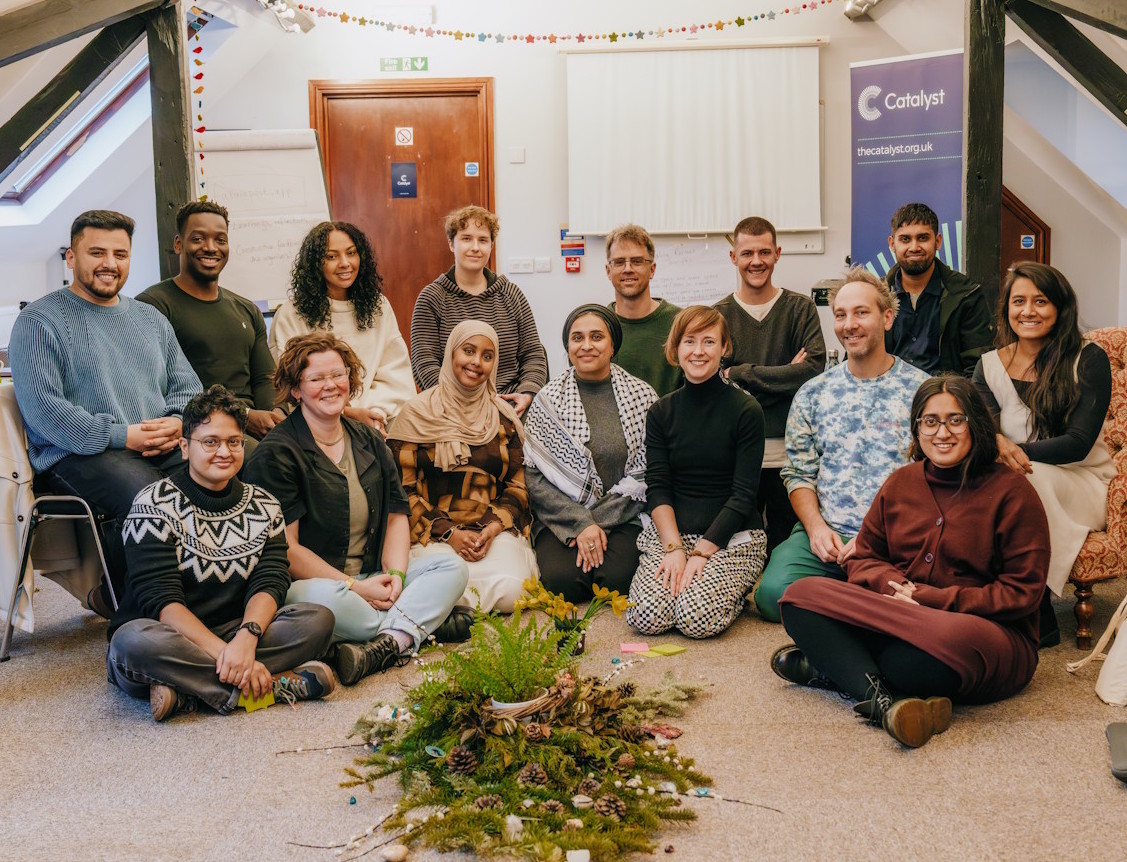
The Kindling Gathering: seeding what comes next
Seven collective learnings from 2 days of tech justice work, care and connection.

What we are learning about tech justice grant making
We received more applications than we could fund. This is a reflective look at what we learned from saying yes, saying no, and trying to...

How we’re choosing stewards for Catalyst’s legacy
How we’re deciding who will look after Catalyst’s tech‑justice assets after March 2026, and what we’re learning about endings, coalitions and care.

Stewarding Catalyst’s Legacy: an invitation
Catalyst’s legacy belongs to the network. You can help sustain and grow it. ⏲️ Submission deadline: Tues 18 November, 5pm 📝 Submissions: Expression of interest...
Kindling Programme: grant funding
Catalyst is seeking 10 individuals and organisations wanting to explore, develop or sustain work that puts tech justice into practice.

Catalyst CIC will close in March 2026
What ends, what persists, how to help steward the legacy.