


Finding the right homes, not any homes: how we’re choosing stewards for Catalyst’s legacy
8th December 2025
Share this article


Joe Roberson

Quick links
How we’re deciding who will look after Catalyst’s tech‑justice assets after March 2026, and what we’re learning about endings, coalitions and care.
When we shared that the CIC would close in March 2026, we also said we would find homes for the assets and activities that have been built with hundreds of people over the past few years. Specifically, those created since we adopted our vision of liberatory tech for just and regenerative futures. This article is a snapshot of how that process is going, and how we are choosing stewards in ways that honour tech justice, our limits, and the wider ecosystem.
What we’re trying to steward
Here’s a list. Note that our earlier resources on digital capacity building were already migrated to ProMo Cymru last year, alongside other rehomed past projects.
Assets
Assets include the Catalyst website, the Tech Justice Evidence Repository, Find a Funder, the Medium archive and the Catalyst handbook.
An asset can live on as a time capsule on the Catalyst website. Some can also be embedded elsewhere (like the Evidence Repository and the Find a Funder directory).
Activities
Activities are things that need ongoing human energy to deliver: the Funder Forum, putting learning from the Tech Justice Circle into action, and any future circles or events that grow out of our Kindling Programme.
An activity usually needs someone to convene, host, and adapt, so we are more likely to see these as things that move into other organisations’ project portfolios.
This distinction is already shaping our decisions.
Archives and living work
For some parts of Catalyst’s legacy there is value in having a clear, accessible archive that shows the journey of the network. For others, such as Find a Funder or the Evidence Repository, the main value is in staying current and being used as part of ongoing organising.
We are therefore looking at combinations like:
- Keeping the Catalyst website online as a time capsule and “intro to tech justice”, while partnering with justice-aligned organisations to embed specific assets (like Find a Funder) in their own sites, with redirects from ours.
- Supporting original authors to continue to hold and grow their work where that makes sense.
- Being open to assets living in more than one place (for example, archives on Catalyst and on a partner’s site) so they can reach different audiences (where this doesn’t compromise search engine findability).
Why ‘tech justice aligned’ matters
From the outside, “legacy interest” can look like a simple technical offer: hosting a website or maintaining a database. In practice, our conversations have shown us a wide spectrum of politics and intentions: from general “digital capacity building” through to groups whose work is rooted in racial, migrant, feminist and decolonial justice
Through calls and expressions of interest, we have found that:
- Some long-standing digital agencies and infrastructure bodies are generous and skilled, but still frame this work mainly as “digital support for charities” rather than tech justice. Others come with explicit commitments to collective power, systemic change, and lived experience at the centre.
- Some applications sound close on language (“justice tech”, “inclusive digital”), but on closer reading are oriented to different goals and audiences than the ones Catalyst has tried to centre.
We are learning that “tech justice aligned” needs to be more than warm words. In our legacy scoping meeting, Joe described feeling more responsibility for “who” than “what”: it matters more to us that assets and activities sit with people whose focus is justice, collective power and regeneration, than with those who could simply keep a thing running.
So we are now being more explicit in our follow-up messages: we are looking for stewards whose work already aligns with tech justice, regenerative practice, and collective power-building, and who want to deepen that through these assets and activities.
What we are looking for in stewards
Across interactions, a few “green flags” are emerging.
We are drawn to:
- Organisations or collectives that name systems of oppression directly (racism, migration injustice, gendered violence, coloniality) and are explicit about how their digital work responds to those.
- People who have thought about growth as “ripples, depth and reach”, not as scale for its own sake – for example, making a resource more findable and useful to the right communities, rather than expanding it into a generic platform.
- Those with lived experience and political commitments that complement what already sits in a resource, such as migrant justice or gender-based violence organising alongside tech justice.
- A willingness to work in coalition, or at least to be in relationship with others in the ecosystem, rather than hold an asset alone.
We are more cautious when:
- A proposal sees legacy assets primarily as tools for innovation or fundraising, without a strong justice lens.
- An organisation is generous and capable, but has not yet articulated any clear tech justice position or practice.
- People are interested in using an asset to deepen their own work, without much sense of maintaining, growing or sharing what already exists for others. (It’s great if that happens, but we want to see more outward-facing commitments from stewards.)
We are not trying to create a perfect checklist. Instead, we are expressing these patterns to help those who expressed interest self-select in or out to a conversation.
Coalitions and how they might work
Several expressions of interest point to the same assets, and some people have said they are open to partnering, so we are thinking more actively about coalitions – groups working together over time – of stewards.
In the scoping session, Ellie and Joe reflected on past coalition work in Catalyst, including governance experiments that were powerful but also challenging. Coalitions can be beautiful and difficult, especially when people do not yet know each other and are coming with different visions and responsibilities.
We would love to seed a small coalition. To give this a chance we are holding a few principles. We will:
- Fund some relational and collaboration time for stewards, not only their delivery efforts. Because Catalyst has always tried to resource the “in-between” work.
- Ask everyone what kind of partnership they imagine – co-designing and co-running, or working more autonomously but in conversation.
- Use our existing relationships to help people see how their work might complement each others’, and then encourage them to build their own consent and ways of working.
Given the limited time and budget available (we are working with something like £15,000 across all assets and activities), this is a delicate balance. We cannot fund everything to full sustainability, but we can make a contribution to the next stage and to the connections around it.
What happens next
Over the next few weeks, we plan to:
- Send a follow-up note to everyone who expressed interest, being clearer about our tech justice expectations and hopes for coalition, and asking them to opt in or out of a call.
- One-to-one calls to explore their motivations, politics, and ideas in more depth, especially where written EOIs sparked our questions.
- Map overlaps between people and assets visually, to see where coalitions might naturally form.
We are deliberately doing this in public, but not in a polished way. Things will change as we learn more, and some decisions will be hard and imperfect. We don’t have this all figured out, and we’d like to listen to any feedback or experiences while we still have time to adjust.

After Catalyst: legacies and new homes
How stewards are carrying Catalyst’s tech justice work into its next chapter.

What our ending reveals
Systemic lessons and calls to action from Catalyst CIC’s closure.
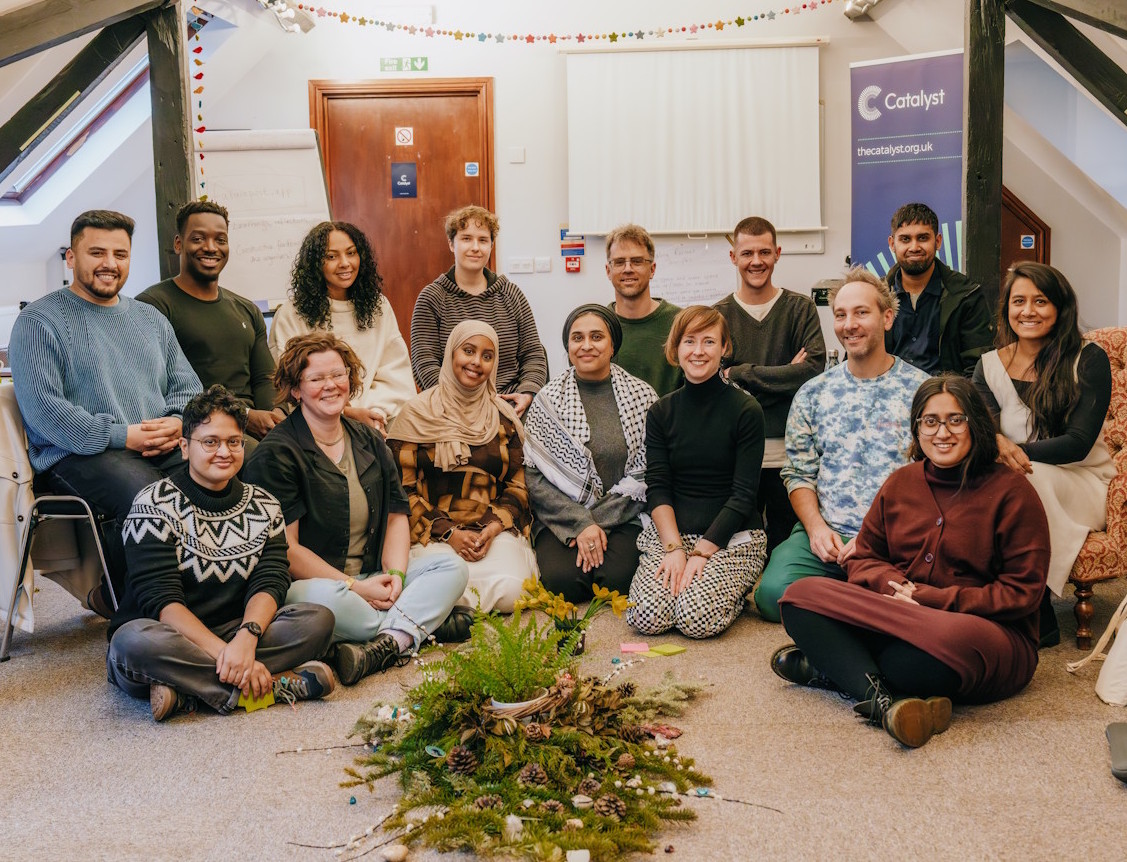
The Kindling Gathering: seeding what comes next
Seven collective learnings from 2 days of tech justice work, care and connection.

What we are learning about tech justice grant making
We received more applications than we could fund. This is a reflective look at what we learned from saying yes, saying no, and trying to...

Stewarding Catalyst’s Legacy: an invitation
Catalyst’s legacy belongs to the network. You can help sustain and grow it. ⏲️ Submission deadline: Tues 18 November, 5pm 📝 Submissions: Expression of interest...
Kindling Programme: grant funding
Catalyst is seeking 10 individuals and organisations wanting to explore, develop or sustain work that puts tech justice into practice.

Catalyst CIC will close in March 2026
What ends, what persists, how to help steward the legacy.