


Celebrating our impact: The Catalyst network’s 2024/25 highlights
3rd July 2025
Share this article


Joe Roberson

Quick links
2024/25 was a turning point for Catalyst. Becoming an independent Community Interest Company let us put justice at the heart of our work. Our achievements this year belong to the whole network—a community of partners, practitioners, and organisations who share knowledge, co-create solutions, and drive change together.
This article shares highlights from our 2025 impact report on what we’ve achieved, what we’ve learned, and where we’re heading next.
“It is difficult to describe Catalyst. It is a group of people, a community of practice, a working culture and set of behaviours and values. It is also a network of organisations who are trying to move in a particular direction.”
(Executive Co-Director, Hannah Turner-Uaandja; Catalyst Impact and Learning Report 2025)
What we delivered together
This year, Catalyst and our network partners worked across projects that put justice, inclusion, and care into practice:
Justice-led innovation and funding
We co-created new models for liberatory technology with justice-led groups, always centring lived experience and participatory funding. Camden Giving led a tech-enabled participatory grant process, awarding £100,000 to four youth-focused groups. Chayn brought together 24 survivors from nine countries to shape feminist AI. Multitudes used emergent design to explore infrastructures for community tech. We funded three more ‘sparks’ projects and published an Afrofuturist-inspired zine, inviting more people into the conversation.
Wellbeing and inclusion
We launched the Wellbeing Fund in direct response to community needs following the racist and Islamophobic riots, offering £1,940 in flexible bursaries to seven network members. This practical support focused on mental health and emotional wellbeing, reflecting our broader commitment to collective care and accessible, stigma-free help. Positive feedback led us to extend the fund to March 2025, recognising its essential role in sustaining leadership and participation.
Network member Zoe Amar brought together activity leads and partners for a DEI Action Learning Set. These sessions helped embed inclusive practices and build a stronger foundation for equity across the network.
Ray Cooper led Agencies for Good DEIJ research, paying underrepresented co-researchers and running events focused on youth, queer, and disability justice. Across three online events, nine contributors shared expertise and approximately 50 people joined the conversation.
Guides, research, and open knowledge
Dawn Kofie published five in-depth, practical Shared Digital Guides that highlight community-led digital inclusion and power-shifting. These guides saw high engagement, averaging 203 unique visitors and 269 views each, with a click-through rate of 9.4%.
Zoe Amar and Nissa Ramsay led the Charity Digital Skills Report, collecting a record 635 responses with strong representation from Black, disabled, young, and older people – setting a new standard for inclusive digital research and providing new insights into DEIJ in sector digital.
Through the Open IP Initiative, CAST supported youth-led digital innovation by making tools and resources openly accessible. Three youth-sector innovation incubators brought together charities, agencies, and young people to co-create new solutions.
Sector convening and practical support
The Catalyst core team convened the Funders’ Forum twice, bringing together funders and grassroots groups to surface barriers and experiment with more equitable, transparent funding relationships. Funders rated the Forum 4 out of 5 stars for usefulness and network-building.
We sponsored two network members to take part in a 12-week Bold Type Inclusive Communication course, helping them bring new skills and insights back to the network.
The Next Steps Fund provided transition funding for 11 legacy initiatives, supporting their sustainability and reflection.
To honour everyone’s contributions to all projects, we made over £30,000 in reciprocity payments in addition to our grants.
Evaluation and learning
Catalyst evaluators inFocus developed new guidance on decolonisation in evaluation, creating a supplementary toolkit and adding two new sections to our guide. Since launch, the guide has seen 54 PDF downloads and 13 unique online views. Fifty-three participants joined a related webinar, and 11 new collaborators came on board to refine the resource further.
Dawn Kofie and Joe Roberson produced 32 new tech justice resources and news items, reaching thousands of readers and helping to spread practical knowledge across the sector.
Making a difference: stories from the network
Our biggest impact came when we put lived experience at the centre. The Tech Justice Roadtrip made this clear:
“It was essential that it be grounded in the thoughts and experiences of survivors… to be granted the time and the resources to do this… that was really transformative for us as an organisation.”
— Eva Blum-Dumontet, Chayn
Camden Giving’s participatory funding tool awarded £100,000 to youth-focused groups, shaped by young people’s input:
“One of them made a comment… just being surprised we had actually built it the way they had specified… that stuck with me. We were not just talking to them for the sake of it.”
— Yasmin Farah, Camden Giving
Both the DEI Action Learning Set and the Wellbeing Fund provided practical, stigma-free support:
“The fund made it possible to hold things together during a challenging time. Access to this kind of support should not be exceptional, but part of how organisations care for people.”
— Wellbeing Fund recipient
The Agencies for Good DEIJ research revealed a gap between inclusive values and lived experience, prompting immediate action through events and new guidance:
“Important that engaging youth is not just a box-ticking exercise! Co-designing rather than just consulting young people. Not just employing people with uni experience.”
— Event participant
How we worked differently
This year, we experimented with new approaches to governance, care, and evaluation:
- We integrated sociocracy into our structures, using consent-based decision-making and shared funding pots, with guidance from Abi Handley and Kayleigh Walsh.
- We piloted new approaches to evaluation that centre community knowledge and move beyond traditional, extractive metrics. inFocus led a workshop on decolonising evaluation, where practitioners shared experiences and co-created a practical workbook. By putting lived experience and community knowledge at the heart of our evidence, we’re redefining what counts as impact.
- We developed a new storytelling handbook, brand identity, and tone of voice guide, all through collaborative processes. Our digital channels – website, newsletter, LinkedIn – continue to grow.
What was hard and what we learned
Measuring systems change is tough. Traditional evaluation frameworks do not always capture the shifts in power, trust, and ways of working that are central to our mission. Much of our progress is relational and emergent, so we are learning to value stories, case studies, and participatory methods as evidence.
Working in an emergent, justice-led way brings challenges. Sometimes, our evolving identity led to confusion or slower progress, but it also laid the groundwork for more equitable ways of working. Becoming an independent CIC was a major milestone, but it brought challenges. The transition took much of the directors’ time and energy, and activity leads delivered funded work while our structure shifted around them. Some welcomed the new model, while others felt unsure about their roles. Despite these growing pains, we kept the quality of activities high, and people appreciated the team’s transparency and support.
Building inclusion into our work required deep thought and commitment. Many partners said Catalyst projects took more headspace than others, because moving from good intentions to real action needs honest discussion and learning (and often a good deal of unlearning too). Some worried about being seen as ‘ticking a box’, but the drive to embed power-shifting, community engagement, and ethical tech led to more genuinely equitable practices. Putting inclusive principles into action takes bravery, care and constant attention, and needs ongoing exploration and more resources in the future.
Looking ahead
We have entered a period of deceleration and discovery. We will focus on deep listening and power-sharing, refining our direction through field engagement. Our next steps include building more direct relationships with grassroots communities, championing tech justice more vocally, and investing in consistent, strategic communications. We remain committed to learning, adapting, and sharing our journey openly as we work towards just digital futures.
Attribution
The network’s impact was made possible by many individuals and partners, each contributing to the work described here. For a full list of contributors and their projects, see the full Catalyst Impact Report 2024/25.
You can also view a summary of the report.
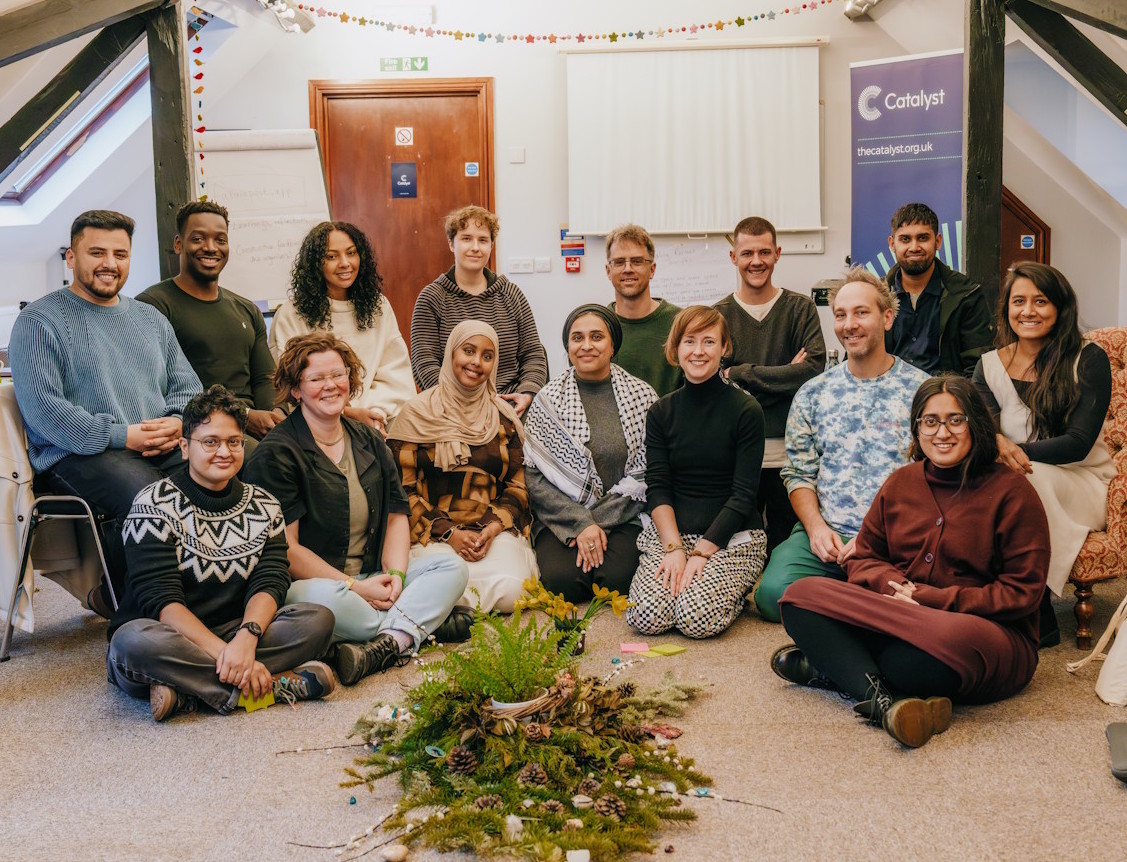
The Kindling Gathering: seeding what comes next
Seven collective learnings from 2 days of tech justice work, care and connection.

Weaving Liberation: organising for tech justice across borders
Weaving Liberation works across Europe (including the UK) to support digital justice organising. Here’s what they do and how to connect.

How 2025's charity digital trends are deepening inequity
Many organisations are investing in tools before investing in justice for the communities they serve. Here are some actions organisations can take in solidarity with...

Kindling Programme: grant funding
Catalyst is seeking 10 individuals and organisations wanting to explore, develop or sustain work that puts tech justice into practice.

Sheeza Shah on her time at Catalyst
As Sheeza Shah steps down as a Catalyst co-director, we asked her to share honest reflections on her journey, the meaning of tech justice, and...

Inside the Tech Justice Road Trip #7
Project members reflect on their time on Catalyst's Tech Justice Road Trip. They share some of their insights and gains from the project. They also...

Inside the Tech Justice Road Trip #6
Project members look back on their past 2 weeks. They share their progress and how their work has impacted others. They also share how belonging...
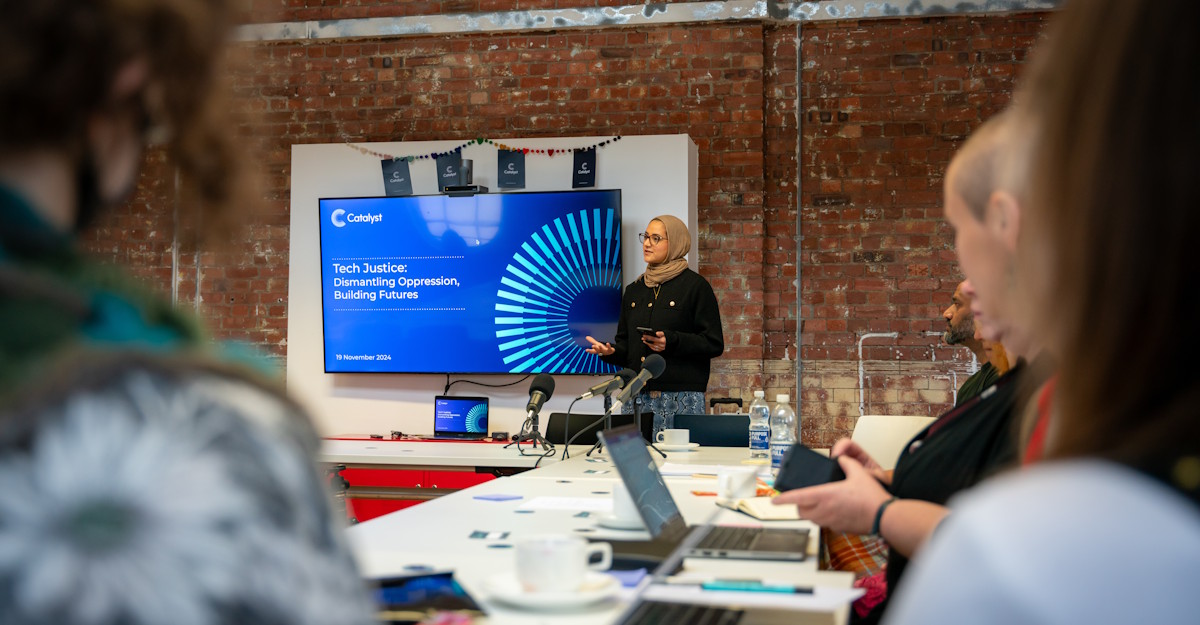
Building a more equitable AI future
AI can increase injustice, or drive liberation. Our latest Funders' Forum brought together not-for-profits and funders to explore who AI is harming. They also considered...

Inside the Tech Justice Road Trip #5
Project members reflect on their past 2 weeks. They share thoughts and opinions on AI, and how to help non-profits focus on tech justice. These...

Inside the Tech Justice Road Trip #4
Project members look back on their work so far. They tell us what’s been on their to-watch and to-read lists. And we find out what's...

Inside the Tech Justice Road Trip #3
Project members share their takeaways from the project’s storytelling workshop and describe their Ustopias. They also share some favourite examples of tech justice.

We piloted a wellbeing support fund: here’s what happened
What if workplace financial support for mental and emotional health was simple, accessible and stigma-free? What happens when we trust employees to decide what’s best...

Inside the Roadtrip #2: defining tech justice and the story so far
We ask project members to describe what tech justice is for them and how they imagine decolonising their evaluation work. They also tell us what's...

Degrowth, discovery and power sharing: why we will be doing less from April 2025
A new era is coming. Soon Catalyst will no longer be an organisation funding a network. Instead we'll be a 'lean organisation, supporting the tech...

Inside the Tech Justice Roadtrip #1: inspiration and challenge
Ever wondered what its like to be part of a sociocracy-inspired, multi-partner tech justice project working on feminist AI, participatory grant making and radical co-design?...

Introducing our new project: The Tech Justice Roadtrip
Working with communities to understand their experience of tech injustice. Reimagining ways that tech can liberate people. Supporting a movement.

Welcoming Sheeza, Kate and Hannah to Catalyst
New skills and experience arrive to freshen up the team. But who are they? And why did they choose to join Catalyst?
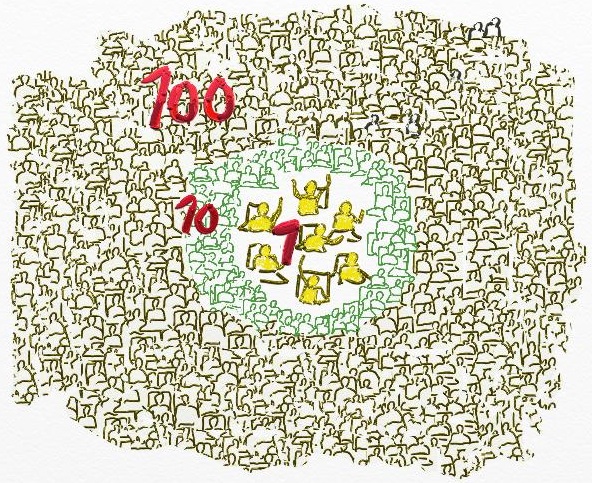
Network views: How AI creates injustice and inequity
We asked the Catalyst community “How do you think AI will (or is) contribute to injustice and inequity in the world?”.

Network views: How AI can create a fairer, more just world
We asked some of the Catalyst community the question “How do you think AI can (or is helping) create a fairer, more just world?”

Who is being left out? Systemic injustices in charities’ approach to digital work
The 2024 Charity Digital Skills Report reveals systemic injustices in digital work, highlighting that small, marginalised charities face significant digital inequalities and need more support.

Two partners, much ruminating, and goodbye to X
Find out why Passion4Social and Catalyst are leaving X, opting to use LinkedIn for community engagement and considering using new platforms to reach our audiences...
Five values, Two perspectives, One outcome
This article describes the partnership between Catalyst and Passion4Social. It is not a typical client-partner relationship. It goes far beyond that!

CAST and Catalyst: the journey, the transition – and beyond
CAST incubated Catalyst for five years, now it's independent. Collaborative review led to Catalyst becoming a Community Interest Company (CIC), with a new vision and...

Looking back, looking ahead: a peek inside Catalyst’s transition
Jo Morfee talks about what the team have been learning and feeling as Catalyst becomes a CiC and adopts a new vision.

Announcement: Catalyst will become a Community Interest Company in April 2024
Following a successful five-year incubation period by CAST, Catalyst is now transitioning to become an independent organisation.
It’s time for an ‘Ustopia‘: The Emerging Tech Justice Landscape in the UK
Dr. Ruha Benjamin advocates for 'Ustopia', challenging tech's harmful impacts, and urging community empowerment. Catalyst's recent research report explores Tech Justice in the UK, emphasizing...