The report
- Read our Manifesto for Just Tech World.
- Download the full Tech Justice Report 2023.
- Read Siana Bangura’s article: It’s time for an ‘Ustopia‘, the Emerging Tech Justice Landscape in the UK.
Envisioning an equitable and tech just world
Connecting communities of interest, digital education, power dynamic shifts and creating coalitions
Collaborators







Interconnectedness
Inviting different perspectives and lenses to the roundtable

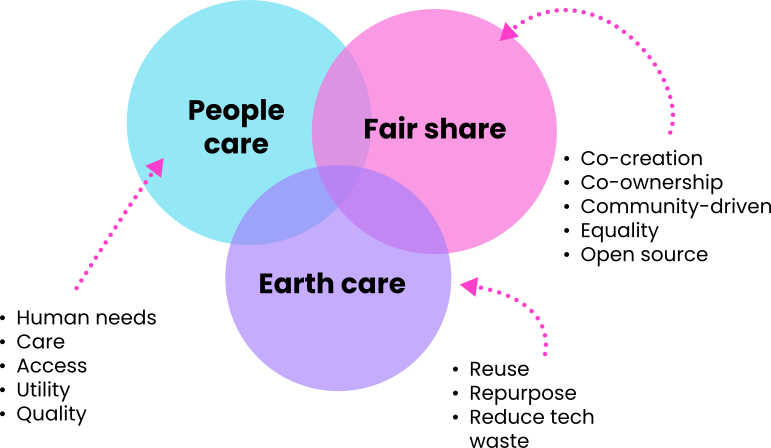
Reimagining with permaculture design
What if we apply permaculture ethics to make a regenerative tech just world?
Tech Justice in its infancy
Tech justice is a relatively new term in the UK. Data justice is seen as the closest definition to tech justice, yet it does not encompass the larger framing of how it is connected to social justice. Overall, it requires a larger framing for different directions and concepts.
BIRDS EYE VIEW
Broad and applicable to the mass concerns of how the deployment of technology impacts communities.
Concerns closest to social justice give us a stronger sense of reframing the root causes, e.g. migrant, racial justice.

Tech justice encompasses everything in these circles and potentially more
ZOOM IN VIEW
More niche and narrow concerns based on the project’s tech experts are working on
Examples
- Application of smart tech to problematic tech (predictive policing)
- Data privacy
Future state: Vision of Tech justice
Tech Justice as an Ecosystem

Anti-oppressive use of technology as gentle breeze.

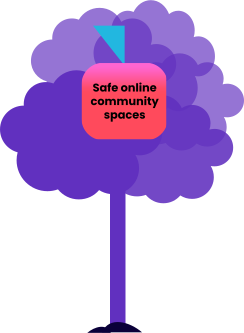
Access and accessibility act as the flowing rivers, providing equal opportunities for all to benefit from technology.

User control and data privacy as a protective canopy, providing shelter and privacy.

Fertile soil
Responsible design and development.
Collaborative roots
Co-design and co-production, including designers, developers, communities to meet specific needs for marginalised groups and match-making with those who work in social justice.
Collaborative roots
Ethics and human rights.

Power shifts possibilities
Military focused

People focused
Tech giants ownership
Community owned
Data owned
Data cooperatives
Expert-led design
Co-designed by all
Human harm
Uphold human rights
"If the sector supported as many nonprofits and individuals to skill up with digital and emerging tech, the future of the sector could belong to smaller, nimble organisations that are digitally savvy. In turn, they could adopt the tools much faster than really large organisations and that in turn would shift power and could re-energise and galvanise the sector."
Expertise and knowledge are decentralised
- How might we foster collaboration between tech experts and movement builders to address tech and social injustice?
- How might we utilise open-source platforms as knowledge-sharing spaces for marginalised groups and encourage inclusive conversations?
Bridge the accessibility gap
Tech justice requires making technology accessible, inclusive and community-owned.
“Those who are marginalised in terms of race, gender, ability, sexual orientation, and migrant status are not hard to reach. It is the tech giants or those in power or wealth you can’t access e.g. Facebook, Bill Gates”
Challenges at Present
Tech is not neutral by default
It can have positive and negative impacts on individuals and communities. People need to have the digital skills to navigate responsibility and safety.
Biases encoded in tech
Biases lead to reinforcing and perpetuating existing systemic issues in society. Biases include class, race and gender, which significantly impact marginalised communities who are unrepresented in the design and development of training algorithms and technology.
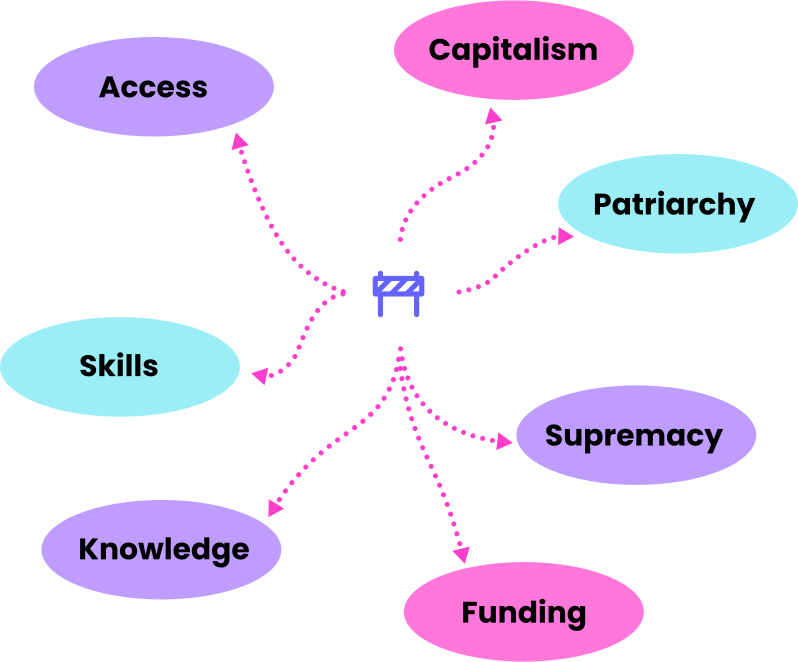
Barriers to a tech just world